Tampilkan postingan dengan label Animals. Tampilkan semua postingan

Sabtu, 03 September 2011

10 Photos of Famous People who look like Animals


You know the old saying: The longer you're together, the more you start to look like your partner. And while this theory usually applies to old married couples, it certainly happens in pet-owner relationships, too (science even says so!).

Tireless theory testers that we are, we set out to find said look-a-likes and expose them in all their twin glory. But actually, there are people who may or may not be a pet owner but looks like pets themselves.

Here's 10 Photos of Famous People who look like Animals. (Note: No, hurt feelings. It's just for fun - I'm a big fan of Taylor Lautner too!)

1 - Flava Flav and a Gremlin

Okay, okay, we know that gremlins aren't real... but we couldn't resist including this pic anyway!


2 - Tina Turner and a Chow Chow

It doesn't make sense though I love Turner and My friend's chow chow.


3 - Prince and a Miniature Pinscher

.... uhmmm. No comment.


4 - Hitler and aCat

There are so many cats who resemble Hitler that there's actually a website called "Cats Who Look Like Hitler!"


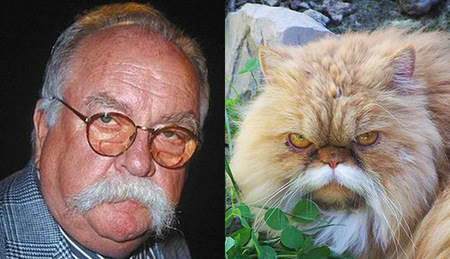
5 - Wilfred Brimley and a Cat

Odd, I usually think of him as a lion. Oh, lion is a member of cat family. LOL.


6 - Dog The Bounty Hunter and a Lion

Now I see a dog and a lion combined...


7 - Mark Zuckerberg and an Elephant Seal

Does it mean that Facebook and Seals are related? Conspicuous. I have to do some research...


8 - Taylor Lautner and a Llama

ET: Jacob, I thought wolves and Llama aren't related?
Jacob: My mothers is a were-Llama.
ET: hmp...


9 - Jack Black and a French Bulldog

Either way, his definitely funny.


10 - Josh Hartnett and a Golden Retriever

I see a golden retriever piloting a aircraft in pearl harbor... was it? Oh, sorry it's Super Dog.


  • Reference/Source: Oddee.com by Beverly Jenkins [8/22/2011]

Minggu, 31 Juli 2011

10 Mindboggling Ways to Remember Your Deceased Pet

I'm always a big fan of Oddee.com because of their bizarre collection of odd things. It's also one of the website where I pick articles to post when I'm out of something to write to. Today, I choose their animal bizarre category.

It's always sad when a beloved pet dies. However, there are more ways than ever to honor its memory, be it by making a fur coat from its hair, jewelry in the shape of its nose or mixing its ashes into a record or a pillow.

1 - Hug A Pillow Containing Their Ashes

If you've ever wanted to give your long gone furry friends a big fat hug, the soft-hearted pillow will let you cuddle up and take a nap with your deceased pet. The Soft-Hearted pillow contains a small plastic pouch that will seal in their ashes tight so you can cuddle them for eternity. You can even personalize your pillow with embroidery or trimmings to further memorialize your critter.


2 - Rock Out With Their Record

Whether you named your pet after a musician or “How Much Is That Doggie In The Window” makes you think of your beloved critter, sometimes music is one of the best ways to remember your lost loved one. That's why And Vinyl presses ashes into vinyl records for you to listen to forever after. You can either use your favorite song or have the company write a track specifically for you and your pet. The company will even paint a portrait of your pet using its ashes and include that as the album's cover art.


3 - Make A Necklace From Their Hair

If your fluffy kitty or puppy left hair all over the house, or if you had a chance to shave off some of their fur before their cremation or burial, you can always try rolling their fur into balls and then turning those balls into jewelry like designer Kate Benjamin.


4 - Wear A Sweater Made From Their Fur

Alternatively, if you want a bigger tribute made from your critter's fur then you can always have the hair turned into yarn and then knitted into sweaters like these people who are part of Erwan Fichou's Dogwool series. While the models used in Fichou's series are given their own jackets made from their dog's fur courtesy of the photographer, you'll have to find your own knitter to work with the fur because Fichou will only accept volunteers who are willing to pose in the jackets beside the pets who provided the fur.


5 - Load Bullets With Their Ashes

Did little Fido love hunting with you? Then why not take him on one more hunt by loading up your shotgun cartridges with his ashes like Joanna Booth did with her husband's ashes? While you can probably find a weapons dealer locally who could help add the ashes to your bullets, Caledonian Cartridge Company in England will most certainly be willing to take on the challenge, being as how they already helped Mrs. Booth with the process.


6 - Form A Diamond With Their Ashes

Pets only live for a short while, but diamonds are forever, so why not let your past pet live on forever in a stunning piece of jewelry? A Japanese company named Lido can turn your pet's ashes into a yellow diamond up to one carat in size, which can then be set into a jewelry piece for you to wear for the rest of your life.


7 - Create Jewelry From Their Nose

Artist Jackie Kaufman uses a quick-forming silicon mold to take imprints of pet's noses, which she then uses to cast metal pendants. While the process is fast enough that it doesn't bother living cats and dogs, it could just as easily be adapted for those who have recently passed away.


8 - Tattoo Them On Your Arm

Sure you could tattoo a portrait of your pet on your arm, but if you really want to personalize your tribute tattoo, you could always incorporate some of your furry friend's ashes. While there are a lot of tattoo shops willing to mix the ashes in with the ink they use, be sure you ask ahead of time because some shops are unwilling to perform this procedure.


9 - Immortalize Them As Art

If you aren't up to inking a permanent tribute of your pet onto your skin, then you can always have a more traditional portrait of them painted by artist Wayne DeFrances, who will incorporate your pet's ashes into the paint he uses.

Note: The Image is for illustration purposes and is not of Wayne DeFrances or his artwork.


10 - Clone Them

If you just can't give up your beloved pet, you can always try cloning them if you have a DNA sample and $50,000 lying around like Bernann McKinney did when she got five clones of her beloved pit bull created. Of course, the new puppy clone may look just like your old furry friend, but it will not grow up to have the same personality and behavioral traits, so really, aren't you better off adopting a new puppy from your local animal shelter?


I will try number 10 to clone Pam(My deceased dog). I missed her a lot. She died when she accidentally cross the street and run on a huge truck. Feels so sad now, though it's been part of our life's journey and the important part is that, once in my life I know someone named Pamela that cheers when I go home everyday.

Rabu, 13 Juli 2011

10 of the World's Most Dangerous Dog Breeds

All dogs (canine family) can be potentially dangerous; however some dogs are more risky than others. Diverse types of Canine breeds can be noticeably stronger and bigger than a person of average size. Training, socialization and proper care can make a considerable impact, though some dogs are by years of breeding more aggressive. After in depth studying and examining the research done by the American Veterinary Medical Association (AVMA), the CDC, and the Humane Society of the United States, a compiled list of 10 of the World’s Most Dangerous Dog Breeds Came out.

Here's Top 10 of the World's Most Dangerous Dog Breeds. Enjoy reading!
10 - Dalmatian

Weight: 40-70 lbs.
Origin: Yugoslavia


The Dalmatian (Croatian: Dalmatinac, Dalmatiner) is a breed of dog whose roots are often said to trace back to Dalmatia, a region of Croatia where the first illustrations of the dog have been found. The Dalmatian is noted for its unique black- or brown-spotted coat and was mainly used as a carriage dog in its early days. Today, this dog remains a well loved family pet and many dog enthusiasts enter their pets into the competitions of many kennel clubs.

Dalmatians are very protective dogs and can be aggressive towards humans. They are very active and need lots of exercise. They have very sensitive natures and an excellent memory. This bred is famed for their intelligence, indepedence, and survival instincts.

9 - Boxer

Weight: 50-70 lbs.
Origin: Germany


Boxer is a breed of stocky, medium-sized, short-haired dog. The coat is smooth and fawn or brindled, with or without white markings. Boxers are brachycephalic (they have broad, short skulls), and have a square muzzle, mandibular prognathism (an underbite), very strong jaws and a powerful bite ideal for hanging on to large prey. The Boxer was bred from the English Bulldog and the now extinct Bullenbeisser and is part of the Molosser group.

Unlike their name suggest, these dogs are not typically aggressive by nature. They are bright, energetic and playful breed. Boxers have been known to be "headstrong", which makes it a bit difficult to train them but with positive reinforcement techniques, Boxers often respond much better.

8 - Presa Canario

Weight: 80-115 lbs.
Origin: Canary Islands


The Perro de Presa Canario is a large Molosser-type dog breed originally bred for working livestock. The name of the breed is Spanish, means "Canarian blood hound," and is often shortened to "Presa Canario" or simply "Presa." The breed is also called Dogo Canario, mean Canarian Molosser.

Originally bred to guard and fight with cattle, an attack by this dog has been described as hopeless for the victim. They are a guardian breed with man-stopping ability, incredible power and a complete lack of fear.

7 - Chow Chow

Weight: 50-70 lbs.
Origin: China


Chow chow is a breed of dog that was developed in China, where it is referred to as Songshi Quan (Pinyin: sōngshī quǎn 鬆獅犬), which literally means "puffy-lion dog".

These dogs can be aggressive if poorly bred. The Chow Chow may appear to be independent and aloof for much of the day but needs constant reinforcement.

6 - Doberman Pinschers

Weight: 65-90 lbs.
Origin: Germany


The Doberman Pinscher (alternatively spelled Dobermann in many countries) or simply Doberman, is a breed of domestic dog originally developed around 1890 by Karl Friedrich Louis Dobermann. Doberman Pinschers are among the most common of pet breeds, and the breed is well known as an intelligent, alert, and loyal companion dog. Although once commonly used as guard dogs or police dogs, this is less common today.

Dobermans are great guard dogs for their alertness, intelligence and loyalty. They can be agressive dogs when provoked. The typical pet Doberman attacks only if it believes that it, its property, or its family are in danger.

5 - Alaskan Malamutes

Weight: 75-100 lbs.
Origin: Nordic


The Alaskan Malamute is a generally large breed of domestic dog (Canis lupus familiaris) originally bred for use as a utilitarian dog, not just an Alaskan sled dog. They are sometimes mistaken for a Siberian Husky, but in fact are quite different in many ways. As pets, once mature, Malamutes have a very quiet, dignified temperament and are loyal to their owners.

These dogs are very energetic and active. If they are bored, they can become destructive. That's why this dog needs lots of exercise to be happy.

4 - Huskies

Weight: 44-66 lbs.
Origin: Alaska


Husky is a general name for a type of dog originally used to pull sleds in northern regions, differentiated from other sled dog types by their fast hard pulling style. The Alaskan Malamute was used for heavier loads and is generally slower in long-distance dogsled racing against smaller and faster Husky type dogs. Huskies are still used in sled racing, and in recent years companies have been marketing tourist treks with dog sleds for adventure travelers in snow regions as well.

Very energetic and intelligent dogs. Not considered a good guard dog because of its personality characteristics and gentle temperament. A 2000 study of dog bites resulting in human fatalities in the U.S. found fifteen such fatalities (6% of the total) were caused by "husky-type" dogs between 1979 and 1997.

3 - German Shepherds

Weight: 70-100 lbs.
Origin: Germany


The German Shepherd Dog (German: Deutscher Schäferhund), also known as an Alsatian or just the German Shepherd, is a breed of large-sized dog that originated in Germany. The German Shepherd is a relatively new breed of dog, with its origin dating to 1899. As part of the Herding Group, the German Shepherd is a working dog developed originally for herding and guarding sheep. Because of its strength, intelligence and abilities in obedience training it is often employed in police and military roles around the world. German Shepherds currently account for 4.6% of all dogs registered with the American Kennel Club. Due to its loyal and protective nature, the German Shepherd is one of the most registered of breeds.

These dogs are intelligent and very alert. They are highly used by local authorities such as the police K-9 unit. German shepherds are known to be fearless and confident dogs.

2 - Rottweilers

Weight: 100-130 lbs.
Origin: Germany


The Rottweiler is a medium to large size breed of domestic dog that originated in Rottweil, Germany. The dogs were known as "Rottweil butchers' dogs" (German: Rottweiler Metzgerhund) because they were used to herd livestock and pull carts laden with butchered meat and other products to market. Some records[which?] indicate that earlier Rottweilers may have also been used for hunting, although the modern Rottweiler has a relatively low hunting instinct.

Rottweilers are known to be very aggressive dogs because of their keen territorial instincts. That's why they make great guard dogs.

1 - Pit Bulls

Weight: 55-65 lbs.
Origin: United States


A Pit bull is any of several breeds of dog in the molosser breed group. Many jurisdictions that restrict pit bulls, including Ontario, Canada, Miami, Florida, U.S. and Denver, Colorado, U.S., apply the restriction to the modern American pit bull terrier, American Staffordshire terrier, Staffordshire bull terrier, or any other dog that has the substantial physical characteristics and appearance of those breeds. However a few jurisdictions, such as Singapore and Franklin County, Ohio, U.S., also classify the modern American Bulldog as a "pit bull-type dog", while in the United Kingdom a pit bull is an American pit bull terrier.

All of the breeds share a similar history, with origins rooted from the bulldog and a variety of terriers. The dogs called bull terriers before the development of the modern Bull terrier in the early 20th century may also be called pit bulls.

A pit bull is a fearless dog that will take on any opponent. They will lock their jaws onto the prey until it's dead. Pit bulls have a reputation of mauling people to death and they are highly sought for dog fighting.

Dogs – in majority often makes a wonderful pet, nevertheless in certain circumstances, any kind of dog can be dangerous. Even friendly dogs, can impose great mischief in the wrong situation.

About PetsDo.com

a property of MarvQuin LLC, is a leading online Pet information and community resource. PetsDo's unparalleled and superior content attracts an audience of pet enthusiasts, novices and everyone in between. Dedicated to delivering an interactive, deep, and engaging environment 100-percent focused on Pets, PetsDo offers reviews and previews, videos, breaking news, and more. PetsDo also has an engaged, active community where like-minded pet owners and lovers interact via forums, ratings, blogs, groups, user generated video, images and more.

Rabu, 15 Juni 2011

10 of the Most Frightening Sea Monsters

Sea monsters are sea-dwelling mythical or legendary creatures, often believed to be of immense size.
Marine monsters can take many forms, including sea dragons, sea serpents, or multi-armed beasts. They can be slimy or scaly and are often pictured threatening ships or spouting jets of water. The definition of a "monster" is subjective, and some sea monsters may have been exaggerations of scientifically accepted creatures such as whales and types of giant and colossal squid.

Here's The top10 of the Most Frightening Sea Monsters
10 - Megalodon

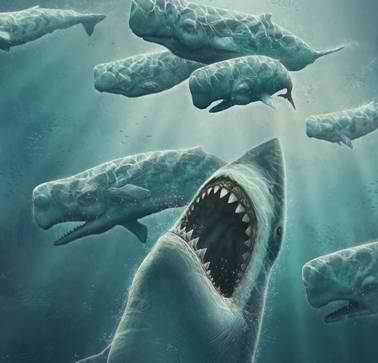
Megalodon is probably the best-known creature in the list; it’s hard to keep the idea of a shark the size of a school bus out of pop culture. Plus, science-minded entertainment sources like the Discovery Channel love creatures that could pass for a movie monster. Despite the popular idea that Megalodon coexisted with dinosaurs, they lived from 25 to 1.5 million years ago, meaning that at best they missed the last dinosaur by 40 million years. On the other hand, this meant they might have still been around for the first humans. Eek.

Megalodons swam the warm oceans that were around until the last ice age in the early Pleistocene, which may have robbed them of their breeding grounds and food. Sometimes, it seems nature has our back.
9 - Liopleurodon

If Jurassic Park had an aquarium scene, and actually featured more animals from the Jurassic period, liopleurodon probably would have been in it. Although the actual length of these beasts is contested (some scientists have claimed lengths in excess of 50’), most agree that it was around 20 feet in length, with a full fifth of that being pointy-toothed head. When the mouth of the “smaller” estimate is still plenty large to eat you whole, I think that is perfectly huge enough.
Scientists have tested the paddle design of these creatures on small swimming robots and found that although they would not have been incredibly fast, they were incredibly agile. They also would have been able to make short, fast burst attacks like crocodiles, which in no way makes them any less intimidating
8 - Basilosaurus

Despite the name and appearance, that is not a reptile, but actually a whale (and not even the most fearsome on the list!) Basilosaurs were predatory ancestors of modern whales, and could be 50 to 85 feet long! It is described as being the closest a whale has ever come to being a snake because of how long and sinuous it was. Imagine swimming in the ocean with an 80+ foot long alligator-snake-whale. Now imagine being afraid to even take a bath ever again.
Physical evidence suggests that basilosaurus did not have the cognitive ability of modern whales, nor the ability to echolocate, and could only navigate in 2 dimensions (so no deep diving or breaching). So at least this monster whale was dumber than a bag of prehistoric hammers and could not chase you if you dove or scrambled out on dry land, probably forever.
7 - Jaekelopterus rhenaniae

Nothing about the words “sea scorpion” are comforting to begin with, so this should not come off as too awful: this was one of the two largest arthropods to have ever lived, reaching a length of over 8 feet of armored, clawed horror. Most of us freak out at the thought of inch-long ants and foot wide spiders, so it’s easy to imagine screaming like a little girl if you ever stumbled across a living one of these.
On the plus side, sea scorpions (Euripterids) have been extinct since before the dinosaurs, having been wiped out in the Permian Triassic extinction event (which killed 90% of all life on earth) and are only survived, to some degree, by horseshoe crabs, which are even less formidable than regular crabs. There is no evidence that any sea scorpions were actually venomous, but the structure of their tail is similar to a modern scorpion’s, so it might have been.
6 - Mauisaurus

Mauisaurus was named after the Maori god Maui, who pulled the islands of New Zealand up from the sea floor with a fish hook, so already you know this thing is going to be enormous. The neck of Mauisaurus measured up to 49 feet long; the longest proportionate (and really, “actual”) neck of any living thing aside from some sauropod dinosaurs. Their overall length was about 66 feet, and that ridiculously long neck had plenty of vertebrae, implying that it was flexible. Imagine a snake strung through a sea turtle with no shell, and you have an approximate idea of what this thing looked like.
It lived back in the Cretaceous era, meaning that creatures that jumped in the water avoid Velociraptors and Tyrannosaurs had to contend with these; the jury is out on which is worse. As far as science can tell, Mauisaurus was limited to the New Zealand area, showing that the area that would one day become Australia and its neighbors was always a land of terror.
5 - Dunkleosteus

Dunkleosteus was a 30 foot long carnivorous tank. It was outlasted by sharks, but I am sure that is small consolation for the variety of creatures this beast ate. Instead of teeth, it had bony ridges, like a turtle. It has been calculated that they had a bite force of 8,000 pounds per square inch, putting it on par with crocodiles and T-Rex in terms of being history’s strongest biters. They also believe, based on the evidence in the skull regarding its musculature, that it could have opened its mouth in one fiftieth of a second, meaning it vacuumed food into its guillotine of a mouth.
The plates that made up the “teeth” changed as the fish aged from a solid, rigid jaw to segments that allowed it to hold prey easier, and made it more effective in biting through the bony plate armor of other armored fish. In the arms race that was the prehistoric ocean, Dunleosteus was a predatory super tank.
4 - Kronosaurus

Kronosaurus is another short-necked pliosaur (like Liopleurodon up at number 9), and like Liopleurodon, its overall length has been contested. It was a “mere” 30 feet long and the longest teeth in its massive mouth were up to 11 inches long. This is why it was named after Cronus, the king of the old Greek Titans.
Guess where it lived? If you guessed “Australia”, then you have been paying attention to life (and are correct). The head was up to 9 feet long. They could eat an entire modern man whole, and still have room left over for half of another. It has also been suggested that since their flippers are so similar in design to those of modern sea turtles, that they may have crawled out onto land to lay eggs. You can be sure no one was digging up these thing’s nests to get at the eggs.
3 - Helicoprion

These sharks grew to be about 15 feet long, and had a lower jaw that was made of a “tooth whorl”. It looks like a cross between a circular saw and a shark, and when you mix apex predators with power tools, the world quakes in fear.
Helicoprion’s teeth were serrated, implying that they were definitely carnivores, but there is some debate as to whether their teeth were in the front of the mouth, as shown in the picture, or if they were farther back, which would suggest a softer diet, like jellyfish. However it was arranged, it clearly worked; Helicoprion survived the Permian Triassic extinction, which means they may have been smart enough to create bomb shelters. Or maybe they just lived in the deep sea.
2 - Livyatan melvillei

Remember me mentioning “hypercarnivorous” whales? Well here it is. Imagine a cross between an orca and a sperm whale. Livyatan melvillei was a whale that ate other whales. It had the largest teeth of any animal to ever use their teeth to eat (elephant tusks are bigger, but they just look impressive and help them smash things; they don’t eat with them) topping out at 1.18 feet. They lived in the same oceans and ate the same food as the Megalodon, so this whale actually had to compete with the largest predatory shark ever.
Not to mention their head was 10 feet long and featured the same echo-locating equipment as modern toothed whales, making them much more effective in murky water. In case it was not obvious, this beast was named after the leviathan, a giant sea monster from the bible, and Herman Melville, who wrote Moby Dick. If the great white whale had been one of these, it would have eaten the Pequot and everyone aboard as a snack.
1 - Giant Stingray

What grew 17 feet across, had a 10 inch poison spike in its tail and was strong enough to drag a boat filled with people? In this case, a prehistoric super-fish that is still lurking around in fresh and brackish waters from the Mekong river to northern Australia. Stingrays have been around since a few million years after the dinosaurs died out, and have proven to be a successful design, much like the sharks they descended from.
The giant stingrays use that tried and true ancient design, but have somehow managed to survive ice ages and even the catastrophic Toba event. They were featured on Animal Planet’s River Monsters, and despite the host’s tendency to exaggerate damn near everything, they are incredibly dangerous to fool around with, even if you don’t know you are fooling around with one. They are notorious for putting their neurotoxin covered spike completely through limbs. I guess, on the plus side, if there is one, at least they won’t try to eat you.

Kamis, 09 Juni 2011

10 of World's Smallest Animals/Creatures

There is something neat about small animals. Even Hollywood's elite enjoy carrying around the diminutive Chihuahuas as a symbol of their status. Whether it's because they look like a baby version of their larger ancestor or because they are so odd, small creatures often attract attention from people.

1 - World’s Smallest Dog: 12.4 cm (4.9-inch) tall

At 1.4 pounds and 4.9 inches tall, Ducky, a yappy short-coat Chihuahua from Charlton (Massachusetts, USA), holds the Guinness World Record for the world's smallest living dog (by height). Ducky succeeds Danka Kordak of Slovakia, a Chihuahua who measured 5.4 inches tall. The smallest dog ever, according to Guinness, was a dwarf Yorkshire terrier who stood 2.8 inches tall.


2 - World's Smallest Snake: 10.1 cm (4-inch) long

Leptotyphlops carlae is the world's smallest species of snake, with adults averaging just under four inches in length. Found on the Caribbean island of Barbados, the species --which is as thin as a spaghetti noodle and small enough to rest comfortably on a U.S. quarter-- was discovered by Blair Hedges.


3 - World’s Smallest Fish: 7.9 mm (0.3-inch) long

On January 2006, the world's smallest fish was discovered on the Indonesian island of Sumatra: a member of the carp family of fish, the Paedocypris progenetica. It is the world's smallest vertebrate or backboned animal; only 7.9 mm (0.3 inches) long.

The title, however, is contested by 6.2 mm (0.2 in) long male anglerfish Photocorynus spiniceps (not technically a fish but a sexual parasite) and the 7 mm (0.27 in) long male stout infantfish Schindleria brevipinguis.


4 - World’s Smallest Horse: 43.18 cm (17-inch) tall

The little horse was born to Paul and Kay Goessling, who specialize in breeding miniature horses, but even for the breed Thumbelina is particularly small: she is thought to be a dwarf-version of the breed. At just 60 lb and 17-inch tall, the five-year-old Thumbelina is the world’s smallest horse.


5 - World’s Smallest Cat: 15.5 cm (6.1-inch) high and 49 cm (19.2-inch) long

Meet Mr. Peebles. He lives in central Illinois, is two years old, weighs about three pounds and is the world's smallest cat! The cat's small stature was verified by the Guinness Book of World Records on 2004.


6 - World's Smallest Hamster: 2.5 cm (0.9-inch) tall

Only slightly bigger than a 50p piece, PeeWee is the smallest hamster in the world. Weighing less than an ounce, the golden hamster stopped growing when he was three weeks old - his five brothers and sisters went on to measure between 4in and 5in.


7 - World's Smallest Chameleon: 1.2 cm (0.5-inch) long

The Brookesia Minima is the world's smallest species of chameleon. This one is just half an inch. Found on the rainforest floor of Nosy Be Island off the north-west coast of Madagascar, females tend to be larger than males.


8 - World's Smallest Lizard: 16 mm (0.6-inch) long

So small it can curl up on a dime or stretch out on a quarter, a typical adult of the species, whose scientific name is Sphaerodactylus ariasae is only about 16 millimeters long, or about three quarters of an inch, from the tip of the snout to the base of the tail. It shares the title of "smallest" with another lizard species named Sphaerodactylus parthenopion, discovered in 1965 in the British Virgin Islands.


9 - World’s Smallest Cattle: 81 cm (31-inch) height

The world’s smallest cattle is a rare breed of an Indian zebu called the Vechur cow. The average height of this breed of cattle is 31 to 35 inches (81 to 91 cm). The photo above shows a 16 year old Vechur cattle as compared to a 6 year old HF cross-breed cow.
10 - World's Smallest Seahorse: 16 mm (0.6-inch) long

The creature, known as Hippocampus denise, is typically just 16 millimetres long - smaller than most fingernails. Some were found to be just 13 mm long. H. denise lives in the tropical waters of the western Pacific Ocean, between 13 and 90 metres beneath the surface.