Tampilkan postingan dengan label Animal Planet. Tampilkan semua postingan

Sabtu, 03 September 2011

10 Photos of Famous People who look like Animals


You know the old saying: The longer you're together, the more you start to look like your partner. And while this theory usually applies to old married couples, it certainly happens in pet-owner relationships, too (science even says so!).

Tireless theory testers that we are, we set out to find said look-a-likes and expose them in all their twin glory. But actually, there are people who may or may not be a pet owner but looks like pets themselves.

Here's 10 Photos of Famous People who look like Animals. (Note: No, hurt feelings. It's just for fun - I'm a big fan of Taylor Lautner too!)

1 - Flava Flav and a Gremlin

Okay, okay, we know that gremlins aren't real... but we couldn't resist including this pic anyway!


2 - Tina Turner and a Chow Chow

It doesn't make sense though I love Turner and My friend's chow chow.


3 - Prince and a Miniature Pinscher

.... uhmmm. No comment.


4 - Hitler and aCat

There are so many cats who resemble Hitler that there's actually a website called "Cats Who Look Like Hitler!"


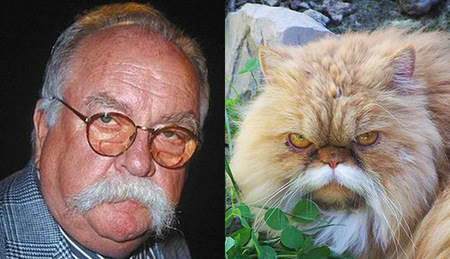
5 - Wilfred Brimley and a Cat

Odd, I usually think of him as a lion. Oh, lion is a member of cat family. LOL.


6 - Dog The Bounty Hunter and a Lion

Now I see a dog and a lion combined...


7 - Mark Zuckerberg and an Elephant Seal

Does it mean that Facebook and Seals are related? Conspicuous. I have to do some research...


8 - Taylor Lautner and a Llama

ET: Jacob, I thought wolves and Llama aren't related?
Jacob: My mothers is a were-Llama.
ET: hmp...


9 - Jack Black and a French Bulldog

Either way, his definitely funny.


10 - Josh Hartnett and a Golden Retriever

I see a golden retriever piloting a aircraft in pearl harbor... was it? Oh, sorry it's Super Dog.


  • Reference/Source: Oddee.com by Beverly Jenkins [8/22/2011]

Rabu, 13 Juli 2011

10 of the World's Most Dangerous Dog Breeds

All dogs (canine family) can be potentially dangerous; however some dogs are more risky than others. Diverse types of Canine breeds can be noticeably stronger and bigger than a person of average size. Training, socialization and proper care can make a considerable impact, though some dogs are by years of breeding more aggressive. After in depth studying and examining the research done by the American Veterinary Medical Association (AVMA), the CDC, and the Humane Society of the United States, a compiled list of 10 of the World’s Most Dangerous Dog Breeds Came out.

Here's Top 10 of the World's Most Dangerous Dog Breeds. Enjoy reading!
10 - Dalmatian

Weight: 40-70 lbs.
Origin: Yugoslavia


The Dalmatian (Croatian: Dalmatinac, Dalmatiner) is a breed of dog whose roots are often said to trace back to Dalmatia, a region of Croatia where the first illustrations of the dog have been found. The Dalmatian is noted for its unique black- or brown-spotted coat and was mainly used as a carriage dog in its early days. Today, this dog remains a well loved family pet and many dog enthusiasts enter their pets into the competitions of many kennel clubs.

Dalmatians are very protective dogs and can be aggressive towards humans. They are very active and need lots of exercise. They have very sensitive natures and an excellent memory. This bred is famed for their intelligence, indepedence, and survival instincts.

9 - Boxer

Weight: 50-70 lbs.
Origin: Germany


Boxer is a breed of stocky, medium-sized, short-haired dog. The coat is smooth and fawn or brindled, with or without white markings. Boxers are brachycephalic (they have broad, short skulls), and have a square muzzle, mandibular prognathism (an underbite), very strong jaws and a powerful bite ideal for hanging on to large prey. The Boxer was bred from the English Bulldog and the now extinct Bullenbeisser and is part of the Molosser group.

Unlike their name suggest, these dogs are not typically aggressive by nature. They are bright, energetic and playful breed. Boxers have been known to be "headstrong", which makes it a bit difficult to train them but with positive reinforcement techniques, Boxers often respond much better.

8 - Presa Canario

Weight: 80-115 lbs.
Origin: Canary Islands


The Perro de Presa Canario is a large Molosser-type dog breed originally bred for working livestock. The name of the breed is Spanish, means "Canarian blood hound," and is often shortened to "Presa Canario" or simply "Presa." The breed is also called Dogo Canario, mean Canarian Molosser.

Originally bred to guard and fight with cattle, an attack by this dog has been described as hopeless for the victim. They are a guardian breed with man-stopping ability, incredible power and a complete lack of fear.

7 - Chow Chow

Weight: 50-70 lbs.
Origin: China


Chow chow is a breed of dog that was developed in China, where it is referred to as Songshi Quan (Pinyin: sōngshī quǎn 鬆獅犬), which literally means "puffy-lion dog".

These dogs can be aggressive if poorly bred. The Chow Chow may appear to be independent and aloof for much of the day but needs constant reinforcement.

6 - Doberman Pinschers

Weight: 65-90 lbs.
Origin: Germany


The Doberman Pinscher (alternatively spelled Dobermann in many countries) or simply Doberman, is a breed of domestic dog originally developed around 1890 by Karl Friedrich Louis Dobermann. Doberman Pinschers are among the most common of pet breeds, and the breed is well known as an intelligent, alert, and loyal companion dog. Although once commonly used as guard dogs or police dogs, this is less common today.

Dobermans are great guard dogs for their alertness, intelligence and loyalty. They can be agressive dogs when provoked. The typical pet Doberman attacks only if it believes that it, its property, or its family are in danger.

5 - Alaskan Malamutes

Weight: 75-100 lbs.
Origin: Nordic


The Alaskan Malamute is a generally large breed of domestic dog (Canis lupus familiaris) originally bred for use as a utilitarian dog, not just an Alaskan sled dog. They are sometimes mistaken for a Siberian Husky, but in fact are quite different in many ways. As pets, once mature, Malamutes have a very quiet, dignified temperament and are loyal to their owners.

These dogs are very energetic and active. If they are bored, they can become destructive. That's why this dog needs lots of exercise to be happy.

4 - Huskies

Weight: 44-66 lbs.
Origin: Alaska


Husky is a general name for a type of dog originally used to pull sleds in northern regions, differentiated from other sled dog types by their fast hard pulling style. The Alaskan Malamute was used for heavier loads and is generally slower in long-distance dogsled racing against smaller and faster Husky type dogs. Huskies are still used in sled racing, and in recent years companies have been marketing tourist treks with dog sleds for adventure travelers in snow regions as well.

Very energetic and intelligent dogs. Not considered a good guard dog because of its personality characteristics and gentle temperament. A 2000 study of dog bites resulting in human fatalities in the U.S. found fifteen such fatalities (6% of the total) were caused by "husky-type" dogs between 1979 and 1997.

3 - German Shepherds

Weight: 70-100 lbs.
Origin: Germany


The German Shepherd Dog (German: Deutscher Schäferhund), also known as an Alsatian or just the German Shepherd, is a breed of large-sized dog that originated in Germany. The German Shepherd is a relatively new breed of dog, with its origin dating to 1899. As part of the Herding Group, the German Shepherd is a working dog developed originally for herding and guarding sheep. Because of its strength, intelligence and abilities in obedience training it is often employed in police and military roles around the world. German Shepherds currently account for 4.6% of all dogs registered with the American Kennel Club. Due to its loyal and protective nature, the German Shepherd is one of the most registered of breeds.

These dogs are intelligent and very alert. They are highly used by local authorities such as the police K-9 unit. German shepherds are known to be fearless and confident dogs.

2 - Rottweilers

Weight: 100-130 lbs.
Origin: Germany


The Rottweiler is a medium to large size breed of domestic dog that originated in Rottweil, Germany. The dogs were known as "Rottweil butchers' dogs" (German: Rottweiler Metzgerhund) because they were used to herd livestock and pull carts laden with butchered meat and other products to market. Some records[which?] indicate that earlier Rottweilers may have also been used for hunting, although the modern Rottweiler has a relatively low hunting instinct.

Rottweilers are known to be very aggressive dogs because of their keen territorial instincts. That's why they make great guard dogs.

1 - Pit Bulls

Weight: 55-65 lbs.
Origin: United States


A Pit bull is any of several breeds of dog in the molosser breed group. Many jurisdictions that restrict pit bulls, including Ontario, Canada, Miami, Florida, U.S. and Denver, Colorado, U.S., apply the restriction to the modern American pit bull terrier, American Staffordshire terrier, Staffordshire bull terrier, or any other dog that has the substantial physical characteristics and appearance of those breeds. However a few jurisdictions, such as Singapore and Franklin County, Ohio, U.S., also classify the modern American Bulldog as a "pit bull-type dog", while in the United Kingdom a pit bull is an American pit bull terrier.

All of the breeds share a similar history, with origins rooted from the bulldog and a variety of terriers. The dogs called bull terriers before the development of the modern Bull terrier in the early 20th century may also be called pit bulls.

A pit bull is a fearless dog that will take on any opponent. They will lock their jaws onto the prey until it's dead. Pit bulls have a reputation of mauling people to death and they are highly sought for dog fighting.

Dogs – in majority often makes a wonderful pet, nevertheless in certain circumstances, any kind of dog can be dangerous. Even friendly dogs, can impose great mischief in the wrong situation.

About PetsDo.com

a property of MarvQuin LLC, is a leading online Pet information and community resource. PetsDo's unparalleled and superior content attracts an audience of pet enthusiasts, novices and everyone in between. Dedicated to delivering an interactive, deep, and engaging environment 100-percent focused on Pets, PetsDo offers reviews and previews, videos, breaking news, and more. PetsDo also has an engaged, active community where like-minded pet owners and lovers interact via forums, ratings, blogs, groups, user generated video, images and more.

Kamis, 09 Juni 2011

10 of World's Smallest Animals/Creatures

There is something neat about small animals. Even Hollywood's elite enjoy carrying around the diminutive Chihuahuas as a symbol of their status. Whether it's because they look like a baby version of their larger ancestor or because they are so odd, small creatures often attract attention from people.

1 - World’s Smallest Dog: 12.4 cm (4.9-inch) tall

At 1.4 pounds and 4.9 inches tall, Ducky, a yappy short-coat Chihuahua from Charlton (Massachusetts, USA), holds the Guinness World Record for the world's smallest living dog (by height). Ducky succeeds Danka Kordak of Slovakia, a Chihuahua who measured 5.4 inches tall. The smallest dog ever, according to Guinness, was a dwarf Yorkshire terrier who stood 2.8 inches tall.


2 - World's Smallest Snake: 10.1 cm (4-inch) long

Leptotyphlops carlae is the world's smallest species of snake, with adults averaging just under four inches in length. Found on the Caribbean island of Barbados, the species --which is as thin as a spaghetti noodle and small enough to rest comfortably on a U.S. quarter-- was discovered by Blair Hedges.


3 - World’s Smallest Fish: 7.9 mm (0.3-inch) long

On January 2006, the world's smallest fish was discovered on the Indonesian island of Sumatra: a member of the carp family of fish, the Paedocypris progenetica. It is the world's smallest vertebrate or backboned animal; only 7.9 mm (0.3 inches) long.

The title, however, is contested by 6.2 mm (0.2 in) long male anglerfish Photocorynus spiniceps (not technically a fish but a sexual parasite) and the 7 mm (0.27 in) long male stout infantfish Schindleria brevipinguis.


4 - World’s Smallest Horse: 43.18 cm (17-inch) tall

The little horse was born to Paul and Kay Goessling, who specialize in breeding miniature horses, but even for the breed Thumbelina is particularly small: she is thought to be a dwarf-version of the breed. At just 60 lb and 17-inch tall, the five-year-old Thumbelina is the world’s smallest horse.


5 - World’s Smallest Cat: 15.5 cm (6.1-inch) high and 49 cm (19.2-inch) long

Meet Mr. Peebles. He lives in central Illinois, is two years old, weighs about three pounds and is the world's smallest cat! The cat's small stature was verified by the Guinness Book of World Records on 2004.


6 - World's Smallest Hamster: 2.5 cm (0.9-inch) tall

Only slightly bigger than a 50p piece, PeeWee is the smallest hamster in the world. Weighing less than an ounce, the golden hamster stopped growing when he was three weeks old - his five brothers and sisters went on to measure between 4in and 5in.


7 - World's Smallest Chameleon: 1.2 cm (0.5-inch) long

The Brookesia Minima is the world's smallest species of chameleon. This one is just half an inch. Found on the rainforest floor of Nosy Be Island off the north-west coast of Madagascar, females tend to be larger than males.


8 - World's Smallest Lizard: 16 mm (0.6-inch) long

So small it can curl up on a dime or stretch out on a quarter, a typical adult of the species, whose scientific name is Sphaerodactylus ariasae is only about 16 millimeters long, or about three quarters of an inch, from the tip of the snout to the base of the tail. It shares the title of "smallest" with another lizard species named Sphaerodactylus parthenopion, discovered in 1965 in the British Virgin Islands.


9 - World’s Smallest Cattle: 81 cm (31-inch) height

The world’s smallest cattle is a rare breed of an Indian zebu called the Vechur cow. The average height of this breed of cattle is 31 to 35 inches (81 to 91 cm). The photo above shows a 16 year old Vechur cattle as compared to a 6 year old HF cross-breed cow.
10 - World's Smallest Seahorse: 16 mm (0.6-inch) long

The creature, known as Hippocampus denise, is typically just 16 millimetres long - smaller than most fingernails. Some were found to be just 13 mm long. H. denise lives in the tropical waters of the western Pacific Ocean, between 13 and 90 metres beneath the surface.

Sabtu, 07 Mei 2011

10 of World's Strongest Animals Compared to it's Body Weight

Meet the strongest animals in the wild. I found this article appealing... so I decided to add it in our list. thanks to nachocelebrity.blogspot.com for posting such great articles.

Here are the 10 of world's strongest animals.
10 - Grizzly Bear

The grizzly bear (Ursus arctos horribilis), also known as the silvertip bear or just the grizzly or North American brown bear, is a subspecies of brown bear (Ursus arctos) that generally lives in the uplands of western North America. This subspecies is thought to descend from Ussuri brown bears which crossed to Alaska from eastern Russia 100,000 years ago, though they did not move south until 13,000 years ago.
Grizzlies are normally solitary, active animals, but in coastal areas, the grizzly congregates alongside streams, lakes, rivers, and ponds during the salmon spawn. Every other year, females (sows) produce one to four young (commonly two) which are small and weigh only about 500 grams (one pound). A sow is protective of her offspring and will attack if she thinks she or her cubs are threatened.

They are strongest mountain animal, can lift 0,8 times their body weight. Their weight is 1500 pounds and can lift until 1200 pounds.
9 - Mussel

The common name mussel is used for members of several families of clams or bivalvia mollusca, from saltwater and freshwater habitats. These groups have in common a shell whose outline is elongated and asymmetrical compared with other edible clams, which are often more or less rounded or oval.
The word "mussel" is most frequently used to mean the edible bivalves of the marine family Mytilidae, most of which live on exposed shores in the intertidal zone, attached by means of their strong byssal threads ("beard") to a firm substrate. A few species (in the genus Bathymodiolus) have colonised hydrothermal vents associated with deep ocean ridges.
In most marine mussels the shell is longer than it is wide, being wedge-shaped or asymmetrical. The external colour of the shell is often dark blue, blackish, or brown, while the interior is silvery and somewhat nacreous.
The word "mussel" is also used for many freshwater bivalves, including the freshwater pearl mussels. Freshwater mussel species inhabit lakes, ponds, rivers, creeks, canals, grouped in a different subclass, despite some very superficial similarities in appearance.
Freshwater Zebra mussels and their relatives in the family Dreissenidae are not related to previously mentioned groups, even though they resemble many Mytilus species in shape, and live attached to rocks and other hard surfaces in a similar manner, using a byssus. They are classified with the Heterodonta, the taxonomic group which includes most of the bivalves commonly referred to as "clams".

They can hold something two times their body weight. Their shell is very strong, compared to their small body size.
8 - Anaconda

An anaconda is a large, non-venomous snake found in tropical South America. Although the name actually applies to a group of snakes, it is often used to refer only to one species in particular, the common or green anaconda, Eunectes murinus, which is one of the largest snakes in the world.

They can squeeze something same as their own body weight to death. Their weight can reach 550 pounds.
7 - Ox

An ox (plural oxen), also known as a bullock in Australia, New Zealand and India, is a bovine trained as a draft animal. Oxen are commonly castrated adult male cattle (castration makes the animals more tractable), but cows (adult females) or bulls (intact males) may also be used in some areas.
Oxen are used for plowing, for transport (pulling carts, hauling wagons and even riding), for threshing grain by trampling, and for powering machines that grind grain or supply irrigation among other purposes. Oxen may be also used to skid logs in forests, particularly in low-impact, select-cut logging.
Oxen are usually yoked in pairs. Light work such as carting household items on good roads might require just one pair, while for heavier work, further pairs would be added as necessary. A team used for a heavy load over difficult ground might exceed nine or ten pairs.

They can pull and carry something 1,5 times their body weight across rugged terrain. Their weight is 1300 pounds and can pull and carry until 2000 pounds.
6 - Tiger

The tiger (Panthera tigris), a member of the Felidae family, is the largest of the four "big cats" in the genus Panthera. The tiger is native to much of eastern and southern Asia, and is an apex predator and an obligate carnivore. The larger tiger subspecies are comparable in size to the biggest extinct felids, reaching up to 3.3 metres (11 ft) in total length, weighing up to 300 kilograms (660 pounds), and having canines up to 4 inches long. Aside from their great bulk and power, their most recognisable feature is a pattern of dark vertical stripes that overlays near-white to reddish-orange fur, with lighter underparts. The most numerous tiger subspecies is the Bengal tiger, while the largest is the Siberian tiger.

They can carry something two times their own body weight up a ten foot fence. Their weight is 600 pounds and can carry until 1200 pounds.
5 - Eagle

Eagles are members of the bird family Accipitridae, and belong to several genera which are not necessarily closely related to each other. Most of the more than 60 species occur in Eurasia and Africa. Outside this area, just two species (the Bald and Golden Eagles) can be found in the United States and Canada, nine more in Central and South America, and three in Australia.

They are the strongest bird. They can lift something four times their own body weight during flight.
4 - Gorilla

Gorillas are the largest species of primates. Gorillas are ground-dwelling, predominantly herbivorous apes that inhabit the forests of central Africa. Gorillas are divided into two species and either four or five subspecies. The DNA of gorillas is highly similar to that of a human, between 95 and 99% depending on what is counted, and they are the next closest living relatives to humans after the two chimpanzee species.

Gorillas' natural habitats cover tropical or subtropical forests in Africa. Although their range covers a small percentage of Africa, gorillas cover a wide range of elevations. The Mountain Gorilla inhabits the Albertine Rift montane cloud forests of the Virunga Volcanoes, ranging in altitude from 2,200–4,300 metres (7,200–14,100 ft). Lowland Gorillas live in dense forests and lowland swamps and marshes as low as sea level, with Western Lowland Gorillas living in Central West African countries and Eastern Lowland Gorillas living in the Democratic Republic of the Congo near its border with Rwanda.

They can lift something over 10 times their body weight. Their weight is 450 pounds and can lift up to 4600 pounds. Mean, they can lift as heavy as 30 adult humans.
3 - Leafcutter Ant

Leafcutter ants, a non-generic name, are any of 47 species of leaf-chewing ants belonging to the two genera Atta and Acromyrmex. These species of tropical, fungus-growing ants are all endemic to South and Central America and parts of the southern United States.
The Acromyrmex and Atta ants have much in common anatomically; however, the two can be identified by their external differences. Atta ants have 3 pairs of spines and a smooth exoskeleton on the upper surface of the thorax while Acromyrmex have 4 pairs and a rough exoskeleton.
Next to humans, leafcutter ants form the largest and most complex animal societies on Earth. In a few years, the central mound of their underground nests can grow to more than 30 metres (98 ft) across with smaller, radiating mounds extending out to a radius of 80 metres (260 ft), taking up 30 to 600 square metres (320 to 6,500 sq ft) and containing eight million individuals.

They can lift something 50 times their own body weight. Imagine a person who can lift a truck.
2 - Elephant

Elephants are large land mammals in two genera of the family Elephantidae: Elephas and Loxodonta. Three species of elephant are living today: the African bush elephant, the African forest elephant and the Asian elephant (also known as the Indian elephant). All other species and genera of Elephantidae are extinct, some since the last ice age although dwarf forms of mammoths may have survived as late as 2,000 BCE. Elephants and other Elephantidae were once classified with other thick-skinned animals in a now invalid order, Pachydermata.

Elephants are the largest land animals now living. The elephant's gestation period is 22 months, the longest of any land animal. At birth it is common for an elephant calf to weigh 120 kilograms (260 lb). They typically live for 50 to 70 years, but the oldest recorded elephant lived for 82 years.[3] The largest elephant ever recorded was shot in Angola in 1956. This male weighed about 24,000 lb (11,000 kg), with a shoulder height of 3.96 metres (13.0 ft), a metre (yard) taller than the average male African elephant. The smallest elephants, about the size of a calf or a large pig, were a prehistoric species that lived on the island of Crete during the Pleistocene epoch.

Elephants are a symbol of wisdom in Asian cultures and are famed for their memory and intelligence, where their intelligence level is thought to be equal to that of dolphins and primates. Aristotle once said the elephant was "the beast which passeth all others in wit and mind." The word "elephant" has its origins in the Greek ἐλέφας, meaning "ivory" or "elephant".
According to observations, healthy adult elephants have no natural predators,[15] although lions may take calves or weak individuals. They are, however, threatened by human intrusion and poaching.

They are the strongest mammals. Their weight is 12000 pounds and they can carry 20.000 pounds. They can carry as heavy as 130 adult humans.
1 - Rhinoceros Beetle

The rhinoceros beetles or rhino beetles are a subfamily (Dynastinae) of the scarab beetle family (Scarabaeidae). Other common names – some for particular groups of rhino beetles – are for example Hercules beetles, unicorn beetles or horn beetles. There are over 300 known species of rhino beetles.

Many rhino beetles are well-known for their bizarre shapes and large size. Famous species are for example the Atlas Beetle (Chalcosoma atlas), Common Rhinoceros Beetle (Xylotrupes ulysses), Elephant Beetle (Megasoma elephas), European Rhinoceros Beetle (Oryctes nasicornis), Hercules Beetle (Dynastes hercules), Japanese Rhinoceros Beetle or kabutomushi (Allomyrina dichotoma), Ox Beetle (Strategus aloeus) and the Unicorn Beetle (Dynastes tityus).

They are not only the strongest insect but also the strongest animal compared to body weight. They can lift something 850 times their own weight.

Rabu, 04 Mei 2011

10 0f the Global Warming Effects and it's Causes

One of the biggest issues facing us right now is global warming. Its effects on animals and on agriculture are indeed frightening, and the effects on the human population are even scarier. The facts about global warming are often debated, but unfortunately, even if we disagree about the causes, global warming effects are real, global, and measurable. The causes are mainly from us, the human race, and the effects on us will be severe.
1 - Global Warming Cause: Carbon dioxide emissions from fossil fuel burning power plants

Our ever increasing addiction to electricity from coal burning power plants releases enormous amounts of carbon dioxide into the atmosphere. 40% of U.S. CO2 emissions come from electricity production, and burning coal accounts for 93% of emissions from the electric utility industry [EPA, pg. 10]. Every day, more electric gadgets flood the market, and without widespread alternative energy sources, we are highly dependent on burning coal for our personal and commercial electrical supply.
2 - Global Warming Cause: Carbon dioxide emissions from burning gasoline for transportation

Our modern car culture and appetite for globally sourced goods is responsible for about 33% of emissions in the U.S. [EPA pg. 8] With our population growing at an alarming rate, the demand for more cars and consumer goods means that we are increasing the use of fossil fuels for transportation and manufacturing. Our consumption is outpacing our discoveries of ways to mitigate the effects, with no end in sight to our massive consumer culture.
3 - Global Warming Cause: Methane emissions from animals, agriculture such as rice paddies, and from Arctic seabeds

Methane is another extremely potent greenhouse gas, ranking right behind CO2. When organic matter is broken down by bacteria under oxygen-starved conditions (anaerobic decomposition) as in rice paddies, methane is produced. The process also takes place in the intestines of herbivorous animals, and with the increase in the amount of concentrated livestock production, the levels of methane released into the atmosphere is increasing. Another source of methane is methane clathrate, a compound containing large amounts of methane trapped in the crystal structure of ice. As methane escapes from the Arctic seabed, the rate of global warming will increase significantly.
4 - Global Warming Cause: Deforestation, especially tropical forests for wood, pulp, and farmland

The use of forests for fuel (both wood and for charcoal) is one cause of deforestation, but in the first world, our appetite for wood and paper products, our consumption of livestock grazed on former forest land, and the use of tropical forest lands for commodities like palm oil plantations contributes to the mass deforestation of our world. Forests remove and store carbon dioxide from the atmosphere, and this deforestation releases large amounts of carbon, as well as reducing the amount of carbon capture on the planet.
5 - Global Warming Cause: Increase in usage of chemical fertilizers on croplands

In the last half of the 20th century, the use of chemical fertilizers (as opposed to the historical use of animal manure) has risen dramatically. The high rate of application of nitrogen-rich fertilizers has effects on the heat storage of cropland (nitrogen oxides have 300 times more heat-trapping capacity per unit of volume than carbon dioxide) and the run-off of excess fertilizers creates ‘dead-zones’ in our oceans. In addition to these effects, high nitrate levels in groundwater due to over-fertilization are cause for concern for human health.
6 - Global Warming Effect: Rise in sea levels worldwide

Scientists predict an increase in sea levels worldwide due to the melting of two massive ice sheets in Antarctica and Greenland, especially on the East coast of the U.S. However, many nations around the world will experience the effects of rising sea levels, which could displace millions of people. One nation, the Maldives, is already looking for a new home, thanks to rising sea levels.
7 - Global Warming Effect: More killer storms

The severity of storms such as hurricanes and cyclones is increasing, and research published in Nature found:

“Scientists have come up with the firmest evidence so far that global warming will significantly increase the intensity of the most extreme storms worldwide. The maximum wind speeds of the strongest tropical cyclones have increased significantly since 1981, according to research published in Nature this week. And the upward trend, thought to be driven by rising ocean temperatures, is unlikely to stop at any time soon.”
8 - Global Warming Effect: Massive crop failures

According to recent research, there is a 90% chance that 3 billion people worldwide will have to choose between moving their families to milder climes and going hungry due to climate change within 100 years.

“Climate change is expected to have the most severe impact on water supplies. “Shortages in future are likely to threaten food production, reduce sanitation, hinder economic development and damage ecosystems. It causes more violent swings between floods and droughts.”" – Guardian: Global warming causes 300,000 deaths a year
9 - Global Warming Effect: Widespread extinction of species

According to research published in Nature, by 2050, rising temperatures could lead to the extinction of more than a million species. And because we can’t exist without a diverse population of species on Earth, this is scary news for humans.

“Climate change now represents at least as great a threat to the number of species surviving on Earth as habitat-destruction and modification.” Chris Thomas, conservation biologist at the University of Leeds
10 - Global Warming Effect: Disappearance of coral reefs

A report on coral reefs from WWF says that in a worst case scenario, coral populations will collapse by 2100 due to increased temperatures and ocean acidification. The ‘bleaching’ of corals from small but prolonged rises in sea temperature is a severe danger for ocean ecosystems, and many other species in the oceans rely on coral reefs for their survival.

“Despite the oceans’s immensity — 71 per cent of the Earth’s surface with an average depth of almost 4km (2½m) — there are indications that it is approaching its tipping point. For reefs, warming waters and acidification are closing in like a pair of jaws that threaten to make them the first global ecosystem to disappear.” – Times Online: 21st-century Noah’s Ark needed to save coral reefs from extinction